
OnlyFans Ranking Cards: Reading Creator Stability Signals
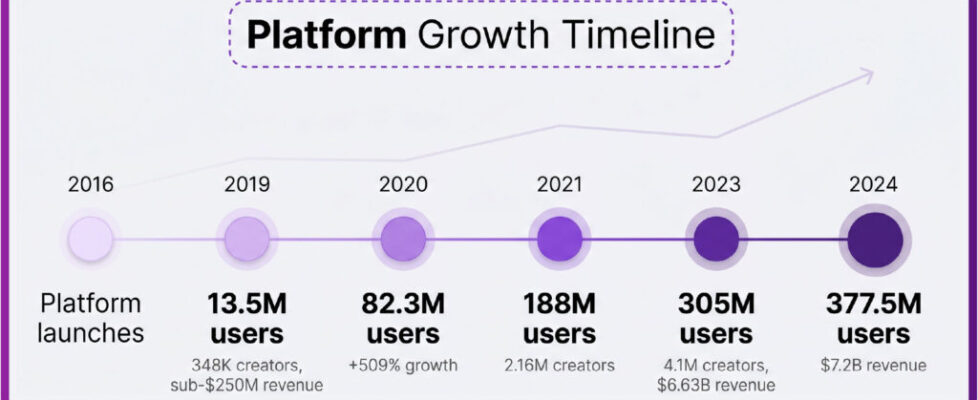
OnlyFans ranking cards solve a problem the platform never addressed: there is no directory, no search, and no price comparison view. This article explains how to read those cards for the two signals that matter most, posting consistency and price history smoothness.
Instead of opening dozens of profiles, you read a few structured fields that describe what a page has charged and how reliably it has published.
Why OnlyFans Lacks Discovery Tools
That design choice pushes discovery onto social media, word of mouth, and third-party ranking sites.
Subscribers who want price transparency must gather it themselves or trust a site that already did the gathering. Neither option is ideal when the only visible number is the one attached to a single page.
- Discovery friction: no search or category browsing means every new page is found somewhere else.
- Price opacity: subscription prices are not aggregated anywhere on the platform itself.
- Social dependency: creators rely on external promotion, so visibility reflects marketing effort more than content quality.
- Stale information: a link shared months ago may point to a page that changed its price twice since.
- Uneven footing: established pages accumulate outside links while new pages stay invisible.
Ranking cards act as a substitute interface, answering the question the platform ignores: what does this page cost, and does it publish on a schedule? The gap is structural, not accidental. OnlyFans has no built-in discovery feed or directory, which is precisely why external ranking sites exist and why their data fields deserve careful reading.
Anatomy of a BestOnlyFans Ranking Card
The typical structure repeats across sites because the underlying data is limited to what is publicly observable: price points, category labels, and activity timestamps.
Methodology matters more than placement. BestOnlyFans treats each field as a separate reliability question rather than folding everything into one score, so position in a list matters less than whether the individual fields describe a stable operation.
| Data Field | What It Displays | Subscriber Relevance |
|---|---|---|
| Base subscription floor | The standard monthly price outside promotions | Shows true recurring cost after any discount ends |
| Active promotional rate | Current first-month or limited-time price | Explains a low entry cost that will not repeat |
| Content category tag | Broad label describing the page’s focus | Confirms the page matches your interest before paying |
| Last-verified activity timestamp | When the page last showed public posting activity | Signals whether the page is currently active |
| Historical price change count | How many times the listed price has moved | Indicates billing predictability over time |
- Base subscription floor, which sets the real recurring cost.
- Current promotional rate, if one is running at the time of the snapshot.
- Content category tag, so you can skip mismatched pages immediately.
- Last-verified activity timestamp, which dates the rest of the data.
- Historical price change count, the simplest volatility measure on the card.
Treat the gap itself as information, because a site that omits price history cannot help you judge stability.
Reading Posting Rhythm Consistency
Activity timestamps look like simple dates, but the spacing between them carries most of the meaning. Five patterns show up repeatedly on ranking cards, and each one implies a different expectation for the coming month.
- Daily streaks: short gaps between timestamps suggest a fixed publishing routine.
- Weekly regularity: timestamps land on the same weekday, indicating a scheduled cadence.
- Burst-then-silence: clusters followed by long gaps suggest promotional pushes rather than steady output.
- Holiday spikes: activity concentrates around seasonal periods, then thins out.
- Dormant with reactivation: a long quiet stretch ending in fresh timestamps suggests a recent restart.
A weekly schedule suits a casual subscriber, while a burst pattern frustrates anyone expecting steady output.
Tip: before subscribing, compare the last ten timestamps on a card and calculate the average gap. If the longest gap is more than three times the average, the page has an interruption pattern worth noting.
Two minutes with a calculator produces a clearer picture of reliability than any single activity badge.
Price History Smoothness as Trust Signal
A smooth line and a jagged line can end at the same number while describing completely different operations, so the shape of the history is the signal.
- Flat lines: the price has held steady, suggesting commitment to the existing subscriber base.
- Gradual increases: small step-ups over time indicate tested demand growth rather than sudden grabs.
- Sawtooth promotions: repeated discount cycles hint at revenue that depends on constant churn.
- Spike then drop: a sharp increase followed by a reversal suggests a failed pricing experiment.
- Free-to-paid transition: a move from $0 to a paid tier signals a deliberate strategy pivot.
Paid subscriptions run from $4.99 to $49.99, with most pages clustering between $5 and $10. Free pages stay at $0 and earn through pay-per-view messages, paid chat, and tips instead.
If a creator raises the price, auto-renew stops for existing subscribers, and access continues only until the paid period ends.
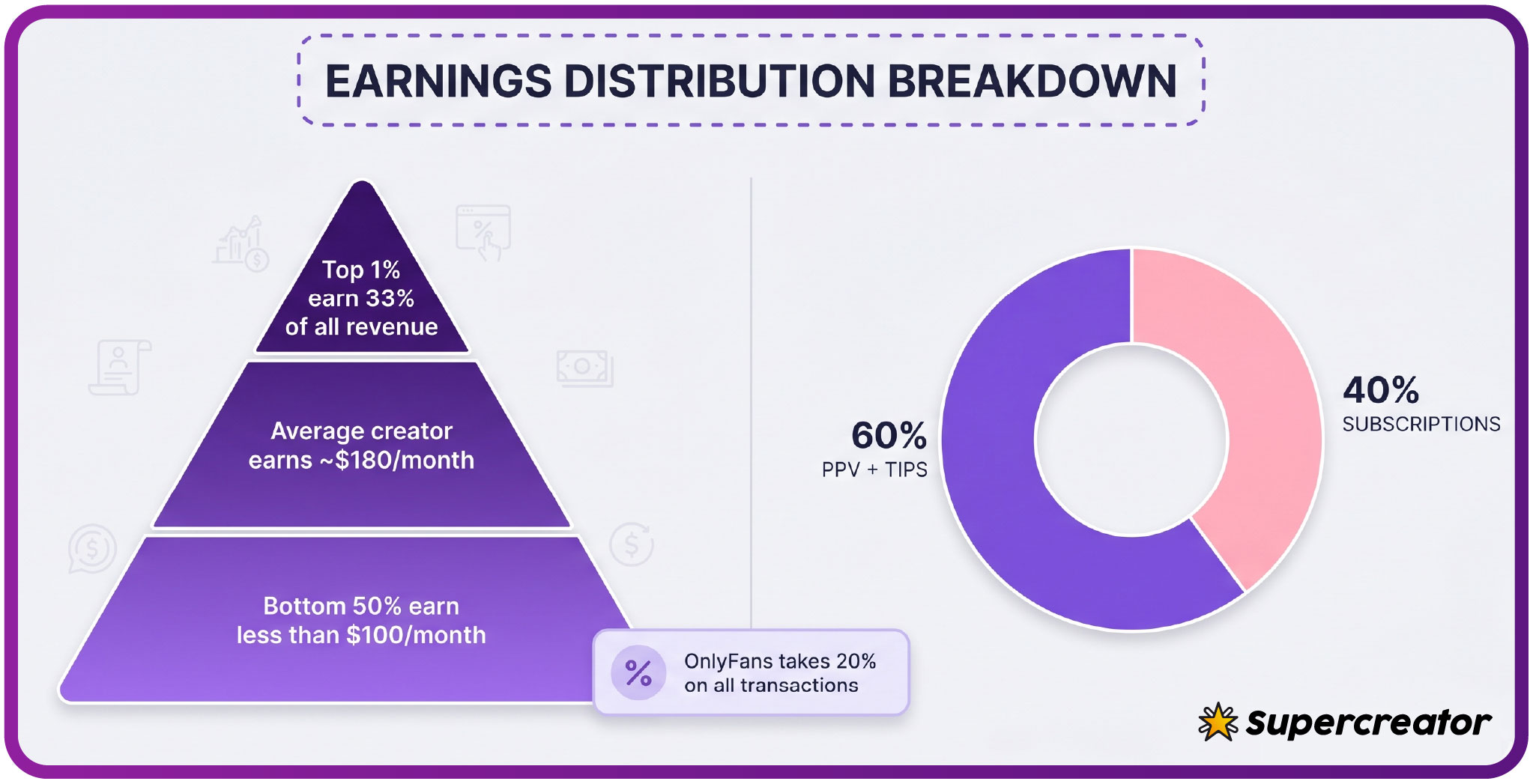
The platform takes a 20% fee on everything, so a creator keeps 80% of each subscription, tip, and unlock. That split shapes pricing behavior, since small base prices require volume while larger ones depend on retention.
When Ranking Data Shows Creator Transitions
Transitions are the hardest signals to read because the data window is short and the outcome is still unknown. Card history may show a $0 floor followed by the introduction of a paid tier, with pay-per-view unlocks and tips continuing alongside it.
Promotional cycling is subtler. A page running a $3 first month, then returning to a base price above $4.99, is using the standard promotion mechanism the platform allows.
When a card shows several adjustments in a short window, the page is testing offers rather than settling into a rate. A card can show what changed and when, but it cannot show why, and the reason usually determines whether the change sticks.
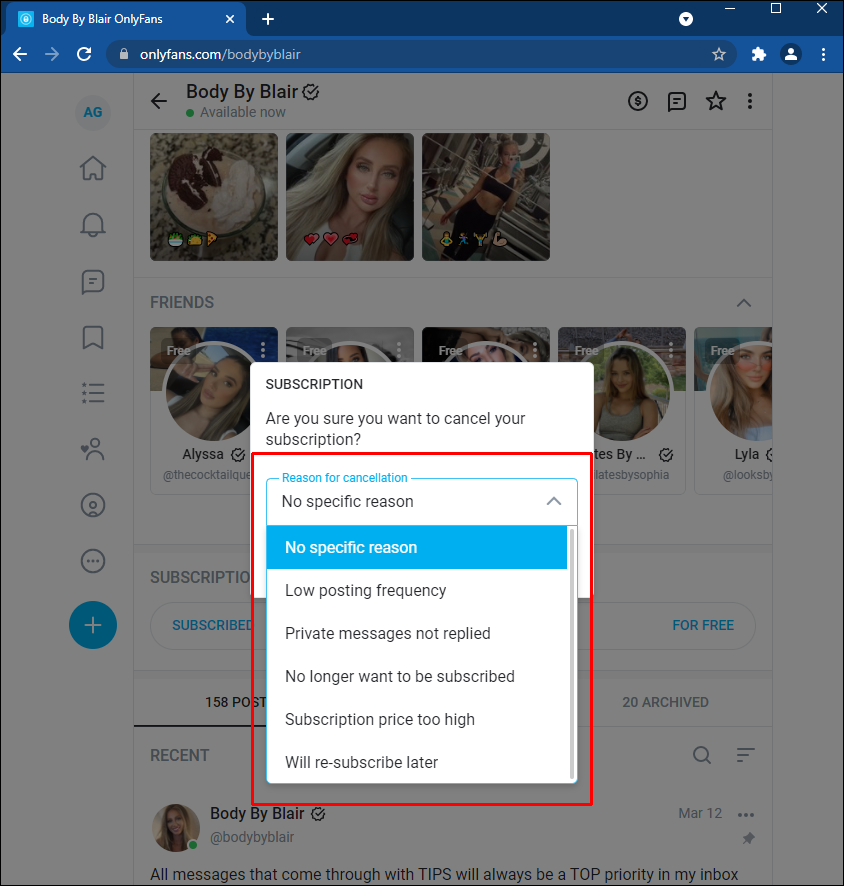
The cancel dialog lists reasons, and subscribers who leave after a price rise are part of the data that later appears on ranking cards as churn pressure.
Cross-Referencing Cards Before Payment
No single ranking source is authoritative, and treating one as final is the most common mistake. Cross-referencing two or more cards catches stale prices, mismatched timestamps, and outright errors before money moves.
| Signal Type | Single Source Risk | Cross-Reference Solution |
|---|---|---|
| Current price | The listed figure may predate a recent change | Compare two cards and check which timestamp is newer |
| Promotional status | A discount may have already expired | Confirm the promotion window on a second source |
| Activity level | An older snapshot may show a page that has since gone quiet | Use the most recent timestamp available across sources |
| Category tag | Labels vary between sites for the same page | Read both tags and weigh the narrower description |
| Price change count | A short history may miss earlier adjustments | Combine histories to approximate the full record |
When two cards disagree, the newer timestamp usually wins, but only if the site documents when it last verified its data. A card with no verification date should be treated as undated and ranked below one that shows its update schedule. Payment safety belongs in the same review, because card verification places a $0.10 hold that is refunded within days and that small charge is a normal part of confirming a payment method.
A card that describes unusual payment requests is a warning sign rather than a pricing detail. Attempts at phishing target subscription sites precisely because recurring billing is predictable. Cross-referencing external cards reduces exposure.
Readers who want a single starting point for comparing pages can use the best onlyfans site as one reference and then verify its numbers against a second source before subscribing.
Limitations of Timestamped Rankings
Ranking data decays. A card verified last week describes last week, and a page can change its price or stop posting the day after a snapshot. Update frequency also varies widely between sites, so two cards can be equally credible and still disagree.
Timestamps describe the past, not the future. A page with a flawless six-month record can still go dormant next month, and no card can promise otherwise.
Coverage gaps matter too. Pages with little public activity generate little data, so new creators often appear on cards with thin histories.

Account-level protections belong alongside data review. Enabling two-step authentication on your own account limits damage from credential theft, which matters more than any single ranking field when billing details are stored.
Building a Subscribable Shortlist from Cards
A shortlist converts reading into deciding. The goal is to sort candidates into three groups: pay now, watch for another month, and pass.
- Check price stability across three or more months before anything else.
- Confirm the posting rhythm matches how often you want new content.
- Treat promotional first-month offers as entry costs, never as the base price.
- Verify the category tag matches the page’s stated content focus.
- Cross-check the card against at least one additional ranking source.
Pages that pass four go into watch, with a note to re-check the card in a month. Anything below that goes into pass, regardless of how the page ranks in a list.
The same discipline applies to ongoing subscriptions. A monthly budget review catches pages whose price trajectory has shifted or whose posting rhythm has slowed, and cancelling before the next renewal is simpler than disputing a charge afterward.
When a billing question does come up, the platform’s own help centre is the correct first stop for payment and account issues. Ranking cards describe pages from the outside; only the platform can resolve a charge, a refund request, or a login problem.
They do make the decision comparable, which is the real gap the platform leaves open.
FAQ
How often does BestOnlyFans update its price data for individual creators?
Cards with recent verification dates are more reliable than undated ones, so check the timestamp before trusting any figure.
What does a flat price history over six months indicate about a creator’s business model?
A flat line usually indicates a page that has settled on a rate and is not testing promotions. It suggests predictable billing, though it says nothing about posting frequency, which is a separate field.
Can ranking card timestamps accurately predict when a creator will post next?
No. Timestamps describe past activity only. A regular pattern raises the odds of continued posting, but no card can guarantee future output or scheduling.
Why do two ranking sites sometimes show different current prices for the same OnlyFans page?
Differences usually come from update timing. One site may have captured a promotion that has since ended, or a price change that the other has not yet recorded.